


When the Sky Changes, the Market Changes
Travel has always followed the invisible lines of geopolitics. When borders shift, when airspace closes, when fuel prices jump overnight - the entire tourism ecosystem quietly reorganizes itself. Routes change. Travelers hesitate. Costs rise. And suddenly, the flow of visitors that once seemed predictable becomes something far more fragile.
In 2026, Thailand’s tourism industry is facing exactly that kind of moment.
Escalating tensions in the Middle East have triggered disruptions across global aviation networks. Several airlines have suspended flights to key hubs in the region, while others operate only limited routes due to security risks and airspace closures. (The Wall Street Journal)
These disruptions ripple outward. The Middle East is not just another region on the map, but of the world’s most important aviation crossroads. Cities like Dubai, Doha, and Abu Dhabi function as massive global transfer hubs connecting Europe, Asia, and Australia. When that system falters, the effects are felt everywhere.
Including Thailand.
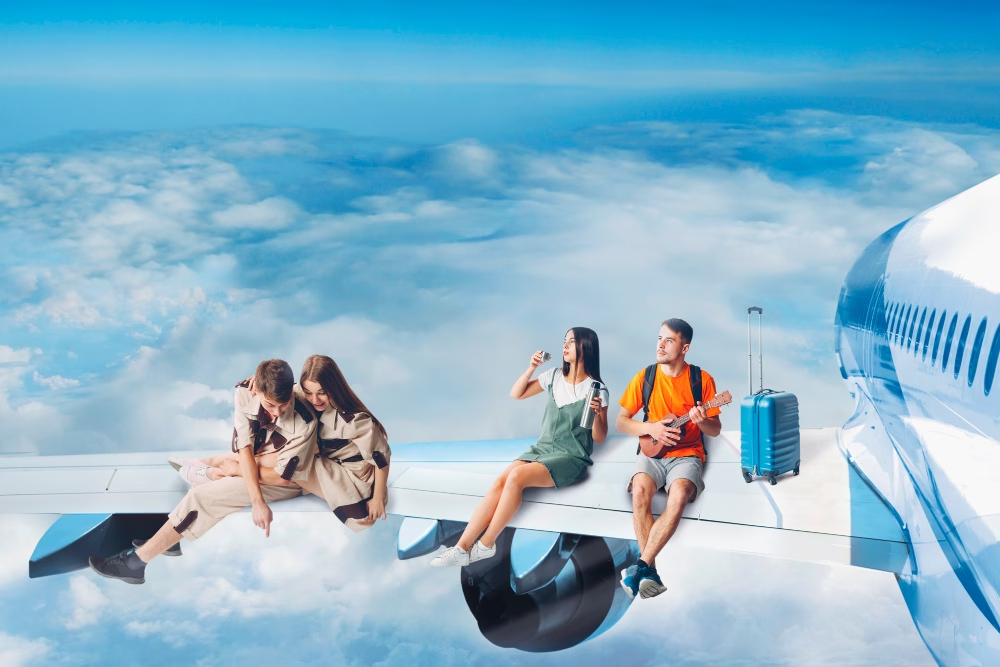
The Fragility of Long-Haul Tourism
Thailand’s tourism economy depends heavily on long-haul travelers. Europeans, Middle Eastern visitors, and travelers from distant markets tend to stay longer and spend more per trip.
But long-haul travel is also the first thing disrupted when geopolitical instability appears.
Airspace closures and rerouted flights are already pushing ticket prices dramatically higher as airlines burn more fuel and operate longer routes. (The Guardian)
For Thailand, the consequences are immediate. Industry analysts warn that if disruptions continue, the country could lose nearly 600,000 foreign visitors and more than 40 billion baht in tourism revenue. (The Phuket News)
Even short disruptions create waves: flight cancellations have already hit key tourism hubs including Phuket, Krabi, and Chiang Mai. (Pattaya Mail)
And beyond logistics lies something less measurable but equally powerful: uncertainty.
When travelers sense instability, even thousands of kilometers away, they pause. They postpone. They choose closer destinations.
Tourism rarely stops completely. It simply moves differently.

The Traveler of 2026 Is More Careful
The modern traveler is not disappearing. But their behavior is evolving. Higher airfares, economic uncertainty, and complex travel routes are encouraging people to rethink how and where they travel. Some markets slow down while others accelerate. Regional tourism strengthens while long-haul markets fluctuate.
In Thailand’s case, industry leaders are already shifting focus toward shorter-haul markets such as India, Malaysia, Singapore, Japan, and Australia to compensate for declining arrivals from Europe and the Middle East. (VnExpress International)
This is the new shape of travel in uncertain times: dynamic, unpredictable, constantly adjusting. For tourism businesses, this shift creates a brutal truth.
Demand does not disappear evenly, but it actually concentrates. And the businesses that capture it are rarely the biggest. They are the most visible.

The Businesses That Disappear First
Every tourism crisis reveals the same pattern. When the market tightens, two types of businesses emerge.
The first group panics. They cut marketing budgets, reduce visibility, and wait for things to improve. On paper it looks like responsible cost-cutting.
In reality, it is often the fastest route to irrelevance.
Because when travelers become more selective, the competition for attention intensifies. Guests compare more options, research more deeply, and rely heavily on digital discovery.
In that environment, the companies that disappear from view are the ones that disappear from bookings.
Then there is the second group.
They do the opposite.
They increase marketing. They strengthen their brand presence. They invest in visibility while competitors go quiet.
History shows this strategy repeatedly winning.
During uncertain times, attention becomes cheaper. Advertising costs drop. Competitors retreat. The brands that remain visible capture disproportionate market share.
In other words: crisis quietly rewards the bold.

Marketing Is Not an Expense. It Is Oxygen.
For many tourism businesses, marketing is still treated like a luxury - something done during good seasons and reduced during slow ones.
But in reality, marketing functions more like oxygen in a competitive market. When conditions become difficult, businesses do not need it less. They need it more.
In 2026, travelers are navigating a complex world of fluctuating airfares, shifting routes, and economic uncertainty. Their decisions increasingly depend on what they see online: inspiring destinations, trustworthy brands, and properties that feel worth the journey.
Visibility becomes survival.
The villas, hotels, and developers that continue investing in strong digital presence - storytelling, search visibility, and brand positioning - will remain discoverable.
Those that vanish from the conversation will quietly lose their place in the market. Not because demand disappeared. But because someone else captured it first.

The Opportunity Hidden Inside Instability
Tourism has always been cyclical. Crises reshape the map. Markets shift. New travelers replace old ones.
And the businesses that thrive through these transitions share one trait: they understand that uncertainty is not only a threat.
It is also a moment of redistribution. When the global travel landscape shifts, attention resets. Travelers explore new destinations. New brands rise. Entire markets reorganize.
Thailand has survived every global tourism disruption of the past decades - financial crises, pandemics, political instability, airline collapses. Each time, the businesses that emerged stronger were not necessarily the largest. They were the ones that stayed visible while others faded into silence. Because in tourism, attention is currency.
And marketing is how you earn it.